
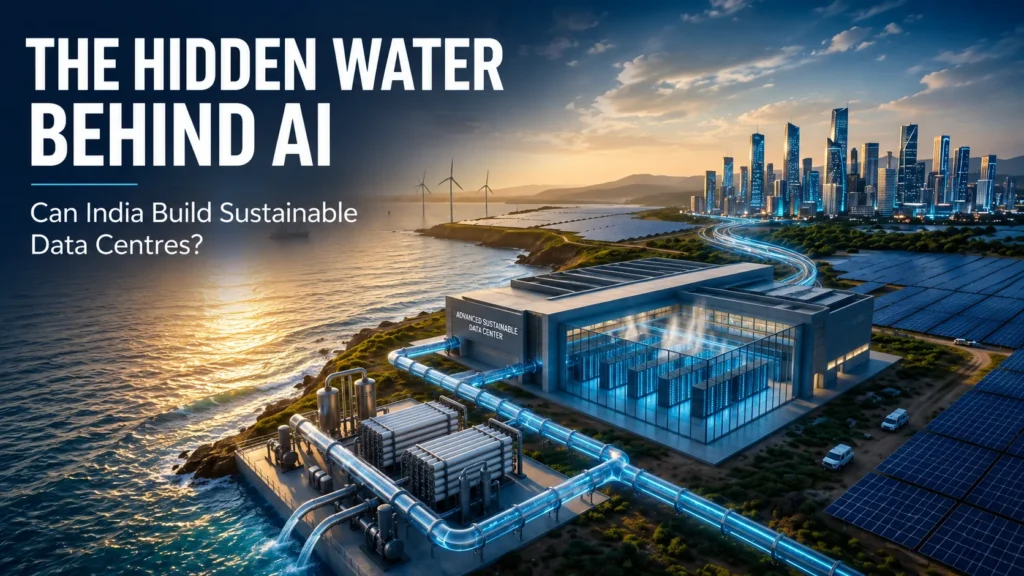
Take a moment and think about everything you’ve done online today.
Before finishing your morning tea, you may have unlocked your phone, replied to a WhatsApp message, searched something on Google, checked your email, asked ChatGPT a question, paid someone through UPI, scrolled through Instagram, or streamed your favourite playlist while getting ready for work.
Later today, you might upload photos to Google Drive, attend a Microsoft Teams meeting, watch a movie on Netflix, order food through Zomato, or spend an hour playing an online game with friends.
To us, these actions feel almost magical. They happen instantly. There are no visible wires. No machines. No noise. Just a screen responding in milliseconds. The internet feels invisible. Almost weightless. But the reality couldn’t be more different.
Every message you send, every movie you stream, every AI prompt you type, and every photo you upload travels through an enormous physical infrastructure spread across the world. Hidden behind our everyday digital experiences are some of the most sophisticated engineering facilities ever built – data centres.
The “cloud” isn’t floating somewhere above us. It lives inside buildings. Massive buildings. Buildings that operate twenty-four hours a day, seven days a week, without interruption.
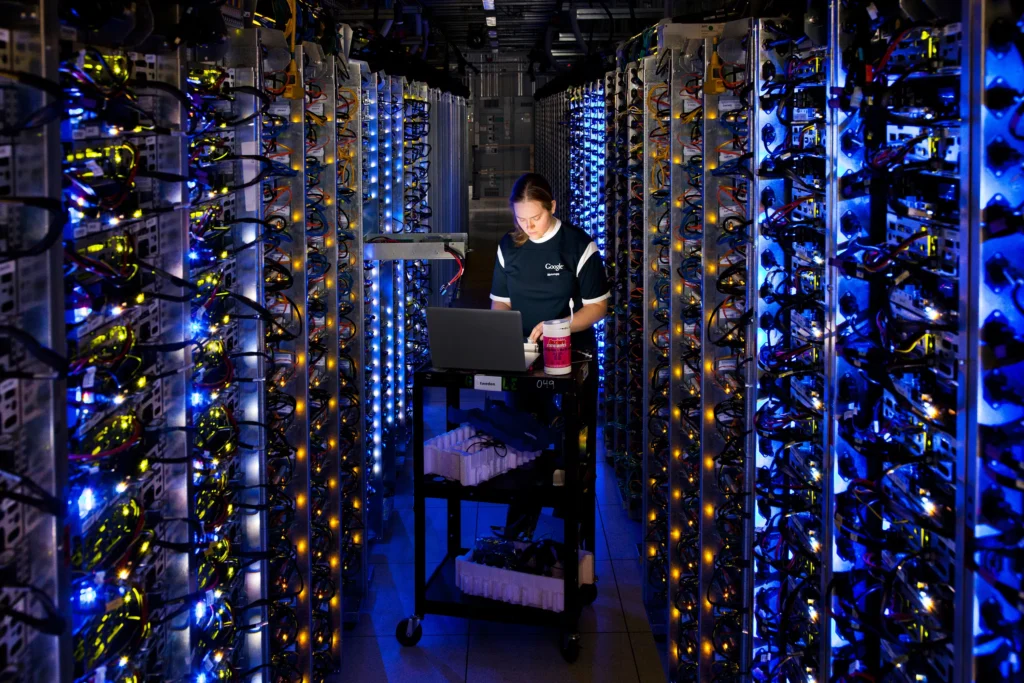
Inside them are thousands – sometimes hundreds of thousands- of servers continuously storing, processing, and transmitting information for billions of users worldwide. Whether it’s online banking, healthcare systems, government portals, cloud storage, enterprise software, e-commerce, social media, or Artificial Intelligence (AI), almost every digital service we rely on depends on these facilities working flawlessly every second of every day.
Without data centres, there would be no cloud computing. No online shopping. No AI assistants. No digital economy.
They have quietly become one of the most important pieces of infrastructure in modern civilization. Yet despite their growing importance, very few people ever stop to ask an equally important question:
What keeps these buildings running?
Most people would probably answer:
Electricity.
And they would be absolutely right. But only partly. Because there is another resource – far less visible, that has become just as important to the future of modern computing.
That resource is water.
The Resource Nobody Associates With AI
When Artificial Intelligence dominates headlines, the conversation usually revolves around computing power, semiconductor chips, GPUs, electricity demand, or carbon emissions.
Water rarely enters the discussion.
In fact, if someone asks you, “Does ChatGPT use water?” you’d probably be confused. How can software use water? After all, you’re simply typing on a keyboard.
Nothing looks remotely connected to water. That’s because the water isn’t being used by your phone or your laptop. It’s being used by the buildings doing the work behind the scenes. Every question you ask ChatGPT, every movie you stream on Netflix, every Google search you perform, and every AI-generated image eventually reach servers inside a data centre. Those servers consume electricity. And wherever electricity flows through processors, one thing inevitably follows:
Heat. Lots of heat.
Modern processors contain billions of microscopic transistors switching on and off billions of times every second. Every one of those tiny electrical operations converts a portion of electrical energy into thermal energy. Individually, the amount of heat is small. Collectively, across tens of thousands of servers operating simultaneously, it becomes enormous.
Now imagine replacing traditional office computers with powerful AI processors.
Instead of answering emails or running spreadsheets, these processors train large language models, generate images, analyse videos, simulate proteins, optimise supply chains, and perform trillions of calculations every second.
They’re significantly more powerful. And significantly hotter.
According to industry research, modern AI-focused GPU racks can require several times the power density of traditional server racks, fundamentally changing how data centres are designed and cooled.
That heat isn’t simply an engineering inconvenience. It’s an existential problem. Without effective cooling, processors quickly exceed their safe operating temperatures. Performance drops. Hardware begins throttling itself. System reliability declines. In extreme cases, equipment can shut down automatically to protect itself from permanent damage. Cooling isn’t a luxury.
It’s what allows the digital world to exist.
India’s Digital Future Is Arriving Faster Than Ever
This conversation becomes even more important when viewed through India’s extraordinary digital transformation.
Over the last decade, the country has experienced explosive growth in internet users, smartphone adoption, cloud computing, fintech, digital payments, e-commerce, online education, and enterprise digitisation. Government initiatives such as Digital India, expanding fibre connectivity, 5G rollout, and increasing data localisation requirements have accelerated demand for modern digital infrastructure. At the same time, Artificial Intelligence has created an entirely new wave of investment as businesses deploy increasingly powerful computing systems.
The result is one of the fastest-growing data centre markets in the world.
Global technology companies, including Amazon Web Services (AWS), Microsoft, Google, and NTT, are expanding aggressively across India. Domestic players such as STT GDC, CtrlS, Reliance, and AdaniConneX are investing billions of dollars into hyperscale facilities capable of supporting the country’s next generation of digital services. Industry estimates suggest that India’s installed data centre capacity has grown rapidly in recent years and is expected to multiply several times again before the end of this decade, although different organisations report varying projections depending on the scope and methodology of their studies.
For India’s economy, this represents a remarkable opportunity. Data centres create jobs. Strengthen digital sovereignty. Support businesses. Enable AI innovation. Improve cloud infrastructure.
But unlike roads or bridges, data centres have another critical dependency that often remains hidden from public conversation. They need to stay cool. And keeping them cool is far more complicated than simply installing a few industrial air conditioners. In fact, understanding how a modern data centre stays cool is the first step toward understanding why water has become one of the defining sustainability challenges of the AI era.
India’s Data Centre Expansion: What Could It Mean for Water?
According to research by the Council on Energy, Environment and Water (CEEW), India’s installed data centre capacity has increased from approximately 520 MW in 2020 to nearly 1.5 GW by mid-2025, with projections suggesting it could reach 4.5–6.5 GW by 2030. This represents one of the fastest-growing data centre markets in the world, driven by hyperscale investments, AI workloads, data localisation requirements, and the rapid expansion of cloud services.
While this growth presents enormous economic and technological opportunities, it also introduces a new engineering challenge. Every additional megawatt of computing capacity generates heat, and that heat must be removed continuously to ensure reliable operation. Depending on the cooling technology employed, this can translate into substantial water demand.
| Parameter | 2020 | Mid-2025 | 2030 (Projected) |
|---|---|---|---|
| Installed IT Capacity | ~520 MW | ~1.5 GW | 4.5–6.5 GW |
| Estimated Investment Commitments | — | ~US$95 billion | >US$100 billion expected |
| Primary Growth Drivers | Cloud Computing | Cloud + AI | AI, HPC, Hyperscale & Sovereign Cloud |
| Approximate Daily Cooling Water Demand* | ~10.4 million L | ~30 million L | ~90–130 million L |
| Approximate Annual Cooling Water Demand* | ~3.8 billion L | ~11 billion L | ~33–47.5 billion L |
| Equivalent Olympic Swimming Pools/Day | ~4 | ~12 | ~36–52 |
*One Olympic-size swimming pool holds approximately 2.5 million litres of water.*
These figures should not be interpreted as predictions of India’s future freshwater consumption. Instead, they illustrate the scale of the engineering challenge if future facilities were to rely primarily on conventional water-intensive cooling systems.
Fortunately, that is not the direction the industry is necessarily taking.
What Actually Happens Inside a Data Centre?
Unlike a conventional manufacturing plant, a data centre doesn’t produce cars, chemicals, pharmaceuticals, or consumer goods.
Its product is information. Every second, enormous amounts of data flow into the facility through fibre-optic cables travelling at nearly the speed of light. Inside the servers, that data is processed, analysed, stored, encrypted, duplicated, and transmitted back across the globe – all within fractions of a second.
When Air Conditioning Isn’t Enough
For most of us, cooling is simple.
If our room gets hot, we switch on the air conditioner. Naturally, many people assume data centres work in exactly the same way. Why not just install a few large air conditioners? The answer lies in scale.
Now imagine a laptop with 100,000 high-performance servers, each operating continuously, every hour of every day.
Suddenly, you’re no longer cooling a room. You’re cooling what is essentially an industrial-scale computing factory. Cooling, therefore, isn’t just another utility.
How Do Data Centres Stay Cool?
When most people hear the term “data centre cooling,” they picture giant air conditioners.
In reality, engineers have developed multiple cooling technologies, each designed to balance performance, energy efficiency, water consumption, climate conditions, and operating costs.
Some facilities rely primarily on air. Others depend heavily on water.
The newest AI-focused facilities are beginning to cool processors using liquids flowing directly across specialised cold plates – or even by immersing entire servers in non-conductive fluids.
Each approach solves one problem while introducing another. Some consume very little water but require more electricity. Others reduce electricity demand but increase dependence on water. Some are ideal for cooler climates. Others perform better in hot, humid environments like much of India.
There is no universally “best” cooling technology.
Instead, engineers choose systems based on local climate, available water resources, energy prices, reliability requirements, environmental regulations, and the type of computing workloads the facility is expected to support.
Common Data Centre Cooling Technologies:
| Cooling Technology | Water Requirement | Energy Efficiency | Typical Application |
|---|---|---|---|
| Air Cooling | Low | Moderate | Conventional data centres |
| Chilled Water | Moderate | High | Enterprise facilities |
| Evaporative Cooling | High | Very High | Dry climates |
| Direct Liquid Cooling | Low | Excellent | AI & GPU clusters |
| Immersion Cooling | Very Low | Excellent | High-density AI workloads |
Water: The Unsung Hero of Cooling
Among the many cooling methods available today, water-based cooling has become one of the most effective for removing large quantities of heat.
Why? Because water is remarkably good at absorbing thermal energy.
Compared with air, water can transport significantly more heat using a much smaller volume, making it an efficient medium for cooling large facilities.
In many conventional data centres, water circulates through chillers, cooling towers, and heat exchangers, carrying heat away from servers before releasing it into the atmosphere.
This approach has enabled decades of reliable digital infrastructure around the world. But it also introduces a difficult question.
Where does all that water come from?
In regions with abundant freshwater resources, the answer may appear straightforward. In water-stressed regions, however, every litre becomes more valuable. As India’s data centre footprint expands, this question is no longer theoretical.
It’s becoming one of the defining sustainability challenges facing the industry.
The Engineering Trade-Off
At first glance, the solution might seem obvious.
Use less water. Problem solved. Unfortunately, engineering rarely works that way. Reducing water consumption often means increasing electricity consumption. Reducing electricity demand may require more water. Choosing one cooling technology may lower operating costs while increasing capital investment.
Every decision involves trade-offs.
This is why the conversation around sustainable data centres has shifted from searching for a single “perfect” solution to finding the right balance between energy efficiency, water stewardship, reliability, economics, and environmental responsibility.
The goal is to build infrastructure capable of supporting decades of digital growth while respecting the natural resources on which that growth depends.
And that’s where one of the most fascinating questions of this entire discussion emerges:
If freshwater is becoming increasingly precious, why don’t data centres simply use seawater instead?
At first glance, it sounds like the perfect solution. India has a coastline stretching over 7,500 kilometres. The oceans contain virtually unlimited water. So why isn’t every coastal data centre pumping seawater directly into its cooling systems? The answer reveals just how challenging water engineering can be.
Can Seawater Solve the Data Centre Water Challenge?
Take a look at a map of India.
The country is blessed with a coastline stretching over 7,500 kilometres, bordered by the Arabian Sea, the Bay of Bengal, and the Indian Ocean. Several of India’s largest data centre markets – including Mumbai, Chennai, Visakhapatnam, Kochi, and other rapidly developing coastal cities- sit within easy reach of this seemingly endless water resource.
At first glance, the conclusion seems obvious. Why worry about freshwater shortages when the ocean contains nearly 97% of Earth’s water?
Why compete with agriculture, households, and industries for freshwater when seawater is available in almost unlimited quantities? For many readers, this appears to be the perfect solution. And, interestingly, many engineers asked exactly the same question. The answer, however, begins with understanding something surprisingly simple.
Not all water is the same.
Why Can’t Data Centres Use Seawater Directly?
When most of us fill a glass from the tap, we rarely think about what’s dissolved inside it. To us, water is simply… water.
Engineers see something very different. Every water source has its own chemical fingerprint. Groundwater differs from river water. River water differs from treated wastewater. Treated wastewater differs from rainwater. And seawater is in a category entirely of its own.
Unlike freshwater, seawater contains approximately 35 grams of dissolved salts per litre, along with a complex mixture of minerals such as sodium, chloride, magnesium, calcium, potassium, sulphates, bicarbonates, and trace elements. It also carries suspended particles, microorganisms, algae, plankton, and organic matter that vary depending on location, season, tides, and coastal activity.
For marine life, this chemistry is perfectly natural. For sophisticated industrial equipment worth millions of dollars… It’s a nightmare.
Scaling: When Minerals Become an Engineering Problem
Salt isn’t the only challenge.
Seawater also carries dissolved minerals that may appear harmless while floating in the ocean but become problematic inside industrial systems. As water moves through pipes, pumps, and heat exchangers, changes in temperature and pressure can cause minerals such as calcium carbonate and magnesium compounds to precipitate out of solution.
Instead of remaining dissolved, they begin attaching themselves to internal surfaces. Layer by layer. Millimetre by millimetre. Until a hard deposit forms. Engineers call this scaling.
You may have already seen a much smaller version of the same phenomenon at home. If you’ve ever noticed a white crust forming inside an electric kettle, around a shower head, or inside a water heater, you’ve seen scale. Now consider the same process occurring inside kilometres of industrial cooling pipelines.
Scale acts like insulation. Heat can no longer transfer efficiently. Pumps work harder. Energy consumption rises. Flow rates decline. Maintenance becomes more frequent. Equipment efficiency gradually drops. For a facility where even small reductions in cooling performance can affect thousands of servers, scaling isn’t merely an inconvenience.
It’s an operational risk.
Biofouling: When Marine Life Enters Industrial Systems
There’s another challenge that receives far less public attention.
The ocean is alive. Every litre of seawater contains microscopic organisms, bacteria, algae, plankton, larvae, and other biological material. When seawater is drawn into industrial systems, these organisms don’t simply disappear. Some attach themselves to intake structures. Others grow inside pipelines.
Over time, these biological deposits restrict water flow, reduce heat transfer efficiency, and increase maintenance requirements.
This phenomenon, known as biofouling, is one of the most persistent challenges in marine engineering. Managing it often requires specialised intake designs, filtration systems, chemical dosing, ultraviolet disinfection, or mechanical cleaning technologies – each adding complexity, operational cost, and environmental considerations.
Once again, the ocean reminds engineers that abundance doesn’t necessarily mean simplicity.
So… Is Seawater a Bad Idea?
Not at all. In fact, seawater has supported major industries for decades. Power plants. Refineries. Petrochemical complexes. And, increasingly, modern data centres.
The challenge is that seawater usually cannot be used directly in sensitive cooling systems. It first needs to be transformed into water that industrial equipment can safely handle. And that’s where one of the most important technologies in modern water engineering enters the story.
Desalination.
Rather than fighting seawater, desalination works with it, carefully removing salts, minerals, suspended particles, and impurities to produce water suitable for industrial processes, drinking water, and, in many cases, advanced cooling systems.
Among the different desalination technologies available today, one method has become the global standard. It is efficient. Scalable. Continuously improving. And it sits at the heart of many of the world’s largest water projects.
It’s called Reverse Osmosis (RO).
Understanding how it works is essential – not only for data centres, but for the future of sustainable water management itself.
Why Desalination Has Become a Global Water Solution
Picture you are standing on the shoreline, looking out toward the Arabian Sea or the Bay of Bengal. In front of you lies an almost limitless supply of water. Enough to fill rivers. Enough to support cities. Enough to cool thousands of future data centres. And yet…
None of it is immediately usable. Not because there’s too little water. But because there’s too much dissolved inside it. This simple observation has shaped water engineering for generations.
As populations expanded, industries grew, and freshwater sources became increasingly stressed, engineers around the world began asking a deceptively simple question:
Can we remove the salt instead of searching for more freshwater?
That question gave birth to one of the most important technologies in modern water management.
Desalination.
Today, desalination plants operate across some of the world’s driest regions – from the deserts of Saudi Arabia and the United Arab Emirates to the coastal cities of Israel, Singapore, Australia, Spain, and parts of the United States. These facilities convert seawater into high-quality freshwater, helping support drinking water supplies, industrial operations, agriculture, and increasingly, large-scale digital infrastructure.
For countries with long coastlines and growing water demand, desalination has shifted from being an emergency solution to becoming part of long-term water planning.
India is beginning to explore that same path.
Desalination: More Than Just Removing Salt
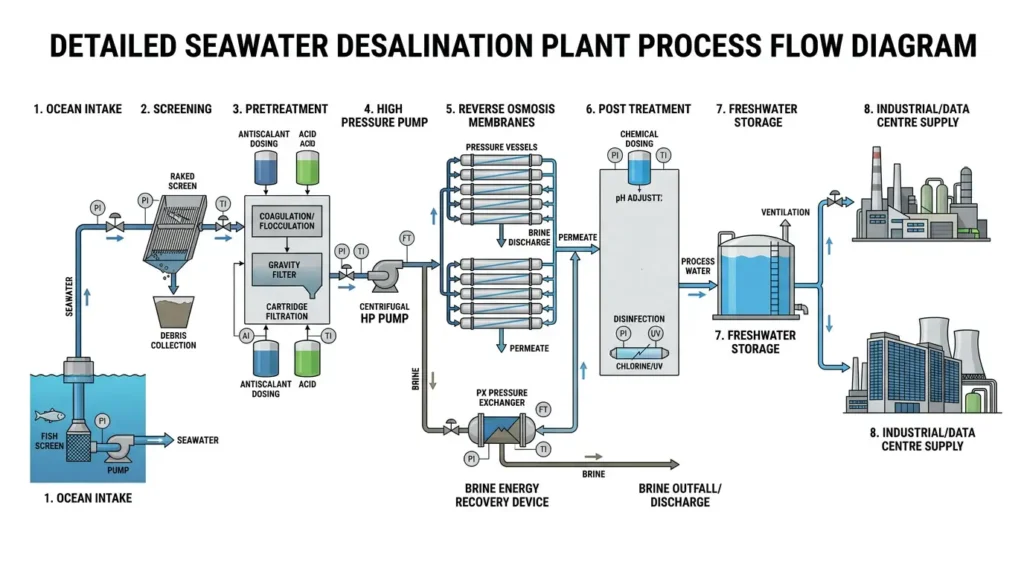
Many people assume desalination simply means “taking salt out of water.” While technically true, that description barely scratches the surface.
Modern desalination is an intricate sequence of engineering processes designed to transform an unpredictable natural resource into water that meets precise quality standards.
Before a single drop reaches an industrial cooling system, it typically passes through multiple stages of treatment. Large intake structures first draw seawater from the ocean while minimising impacts on marine life. Coarse screens remove debris such as seaweed, shells, plastics, and floating material.
Fine filtration systems capture smaller suspended particles. Chemical conditioning may be introduced to control biological growth and protect downstream equipment. Only after this careful preparation is the water ready for the desalination process itself. In many ways, desalination plants resemble highly specialised water treatment facilities rather than simple filtration units.
Not Every Desalination Plant Works the Same Way
Over the decades, engineers have developed several approaches to removing salt from seawater.
Historically, some facilities relied on thermal desalination, where seawater is heated until it evaporates, leaving salts behind before the water vapour is condensed back into freshwater. Technologies such as Multi-Stage Flash (MSF) and Multi-Effect Distillation (MED) became widely adopted in regions with abundant energy resources, particularly in the Middle East.
These systems are exceptionally robust but also highly energy-intensive.
As electricity prices increased and membrane technology advanced, a different approach gradually became the global standard. Instead of boiling water… Engineers began pushing it through incredibly sophisticated membranes.
That technology is known as Reverse Osmosis (RO).
Today, RO accounts for the majority of newly installed desalination capacity worldwide because it generally requires significantly less energy than traditional thermal processes while offering high water quality and scalability. Continuous improvements in membrane design, energy recovery systems, and automation have further strengthened its position as the preferred desalination technology for many municipal and industrial applications.
Reverse Osmosis: Engineering at the Molecular Level
The science behind Reverse Osmosis begins with a familiar concept: osmosis. Under natural conditions, water molecules move through a semi-permeable membrane from a region of lower dissolved salts to one with a higher salt concentration, seeking equilibrium.
Reverse Osmosis simply asks:
What if we force the process to run in the opposite direction?
By applying pressure greater than seawater’s natural osmotic pressure, engineers force water through semi-permeable membranes. Water molecules pass through, while most dissolved salts, minerals, microorganisms, and other impurities are retained.
The purified water produced is known as permeate, while the concentrated saline stream remaining after treatment is called brine, which must be managed responsibly. Although the concept is elegantly simple, achieving it at an industrial scale requires highly engineered systems operating under precise conditions.
Why Reverse Osmosis Is the Preferred Choice for Coastal Data Centres
Today, Reverse Osmosis (RO) is the world’s most widely adopted desalination technology, offering an effective balance between water quality, energy efficiency, scalability, and operational reliability.
For coastal data centres, RO offers several advantages:
| Advantage | Benefit |
|---|---|
| Produces low-salinity water | Protects cooling equipment from corrosion and scaling |
| Mature technology | Proven reliability at industrial scale |
| Modular design | Capacity can grow with demand |
| Compatible with renewable energy | Can be integrated with solar and wind power |
| High automation | Continuous operation with minimal intervention |
Unlike thermal desalination, RO does not rely on evaporating seawater. Instead, it uses high-pressure pumps to force water through semi-permeable membranes that separate dissolved salts from freshwater.
This makes RO particularly attractive for modern industrial applications where both water quality and operational efficiency are critical.
A Journey Through an RO Plant
To appreciate Reverse Osmosis, imagine following a single drop of seawater as it enters a modern desalination facility.
It begins at the intake, where large pumps draw seawater into the plant. The water first passes through coarse and fine screening systems that remove visible debris.
Next comes pretreatment – one of the most critical stages in the entire process. Through a combination of filtration systems, membrane technologies, and carefully controlled chemical dosing, suspended solids, organic matter, microorganisms, and fine particles are removed before the water reaches the RO membranes. Effective pretreatment significantly improves membrane performance and extends system life.
Only after the water has been thoroughly prepared does it reach the high-pressure pumps. These pumps are among the hardest-working components in the entire plant.
Their job is simple to describe but challenging to achieve:
Generate enough pressure to overcome the natural osmotic pressure of seawater and force water molecules through the membranes. Inside the RO vessels, thousands of tightly wound membrane elements perform millions of microscopic separations every second. The process is silent. Invisible. Continuous.
By the time the water leaves the membrane system, it has been transformed from seawater into freshwater suitable for further conditioning before entering industrial cooling systems, municipal networks, or other applications.
A Powerful Solution – But Not a Perfect One
At this point, it might be tempting to conclude that desalination has solved the water challenge. Not quite.
Reverse Osmosis has transformed global water management. It has enabled cities to thrive where freshwater is scarce. It has strengthened industrial resilience. It has opened new possibilities for coastal infrastructure – including data centres. But every engineering solution introduces new questions.
RO plants require significant electricity. They produce concentrated brine. Membranes need cleaning and eventual replacement. Capital investment can be substantial. In other words, desalination doesn’t eliminate trade-offs. It changes them.
Because producing freshwater is only one part of the story.
The next question is even more important:
If we can create new water through desalination… should we also be doing a better job of reusing the water we already have?
That question leads us into one of the fastest-growing ideas in modern water engineering:
Water recycling and the circular water economy.
The Limits of Looking for New Water
Desalination has allowed cities to flourish in deserts, industries to operate in water-scarce regions, and communities to reduce their dependence on unpredictable freshwater sources.
But even the most advanced desalination plant begins with a fundamental reality:
It is creating new freshwater.
That process requires infrastructure. Energy. Investment. Operation and maintenance. Environmental management.
While Reverse Osmosis has become significantly more efficient over the past two decades, producing freshwater from seawater will always require considerably more effort than reusing water that has already been treated.
Picture two scenarios.
In the first, you collect rainwater from your rooftop and use it to water your garden.
In the second, you transport seawater inland, remove dissolved salts, manage concentrated brine, and then use the resulting freshwater for the same purpose.
Both are technically possible. But one clearly requires more engineering. The same principle applies to industrial water management.
Comparison of Industrial Water Sources:
| Water Source | Availability | Treatment Requirement | Sustainability |
|---|---|---|---|
| Municipal Water | Moderate | Low | Moderate |
| Groundwater | Declining | Low | Low |
| Surface Water | Seasonal | Moderate | Moderate |
| Reclaimed Wastewater | High | High | Excellent |
| Desalinated Seawater | Coastal | High | High |
Before creating new water, many engineers now ask a simpler question:
Can we recover the water we already have?
Rethinking Wastewater
The word “wastewater” can be misleading.
It often creates the impression that the water has reached the end of its useful life. In reality, wastewater is rarely “finished.” It simply contains contaminants that must be removed before the water can be safely reused.
Think about the water that leaves a commercial building after people wash their hands. Or the water discharged from a cooling system. Although unsuitable for immediate reuse, much of this water still contains enormous value.
Modern treatment technologies can remove suspended solids, organic matter, nutrients, pathogens, dissolved salts, and other contaminants, allowing water to be used again for applications that do not require potable quality.
Instead of viewing wastewater as something to dispose of, engineers increasingly see it as an alternative water source.
And in a country where freshwater resources are under growing pressure, that shift in perspective may prove just as important as any new desalination technology.
The Journey of Reclaimed Water
Think about a city where wastewater from homes, offices, and commercial buildings no longer flows directly toward disposal. Instead, it enters a modern Sewage Treatment Plant (STP).
Here, large debris is removed. Biological treatment breaks down organic pollutants. Clarifiers separate solids. Disinfection removes harmful microorganisms.
For many applications, this level of treatment may already be sufficient. But for high-value industrial uses such as data centre cooling, additional polishing steps are often introduced.
These may include:
- Sand or multimedia filtration
- Activated carbon filtration
- Ultrafiltration (UF)
- Reverse Osmosis (RO)
- Advanced oxidation processes
- UV disinfection
- Real-time water quality monitoring
The result is reclaimed water that can meet stringent industrial specifications while reducing dependence on freshwater supplies. Rather than flowing out of the city as waste…
The water begins a second life.
Why Reuse Makes Sense for Data Centres
Data centres are unusual consumers of water. Unlike food processing or pharmaceutical manufacturing, they are not incorporating water into a final product.
Their primary objective is to move heat. This distinction is important.
Because once water has been treated to the quality required by a particular cooling system, it can often perform exactly the same cooling function regardless of whether it originally came from a reservoir, a desalination plant, or a reclaimed water facility.
For operators, this creates several potential advantages:
- Reduced dependence on freshwater resources.
- Greater resilience during droughts and water restrictions.
- Improved long-term water security.
- Alignment with corporate sustainability goals.
- Lower pressure on municipal water supplies.
- Stronger support for circular economy initiatives.
However, successful reuse depends on careful engineering. Water quality must remain consistent. Treatment systems require continuous monitoring. Infrastructure must be designed to prevent contamination and ensure reliability.
When Every Drop Matters
The importance of water reuse becomes even clearer when viewed at the scale of a hyperscale data centre.
Consider A facility requiring millions of litres of cooling water over time. Now imagine reducing its freshwater withdrawals by replacing a meaningful portion of that demand with reclaimed water. The impact extends far beyond the facility itself.
Every litre of reclaimed water used for cooling is one less litre that needs to be extracted from rivers, reservoirs, or groundwater sources. At a city scale, these savings become significant. At a national scale, they become strategic.
This is one reason why governments, utilities, technology companies, and environmental organisations increasingly view water reuse not as an optional sustainability measure, but as a key component of long-term water resilience.
Beyond Reuse: Can We Eliminate Wastewater Altogether?
For some industries, simply reusing water isn’t the final objective. The ambition goes even further.
Consider a facility where almost every drop of water is recovered, treated, and returned to the process. Where wastewater discharge approaches zero. Where valuable minerals can even be recovered from concentrated waste streams.
This philosophy has given rise to one of the most advanced approaches in industrial water management:
Zero Liquid Discharge (ZLD).
Rather than viewing wastewater as something to dispose of, ZLD systems aim to recover as much water as technically and economically feasible, leaving behind only concentrated solids for appropriate handling.
While not every data centre will require a full ZLD system, the underlying principle reflects the broader direction of modern water engineering:
Waste less. Recover more. Reuse wherever practical.
Why Zero Liquid Discharge (ZLD) Matters
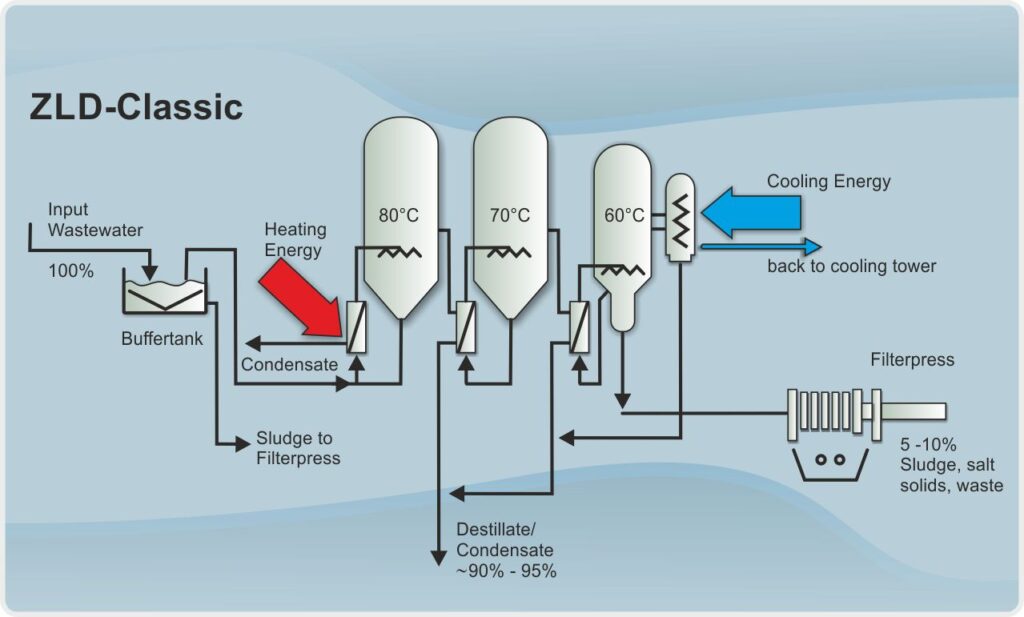
As industries strive to reduce freshwater consumption and comply with stricter environmental regulations, Zero Liquid Discharge (ZLD) has emerged as one of the most advanced water management strategies.
Rather than discharging treated wastewater into the environment, a ZLD system recovers as much water as possible and converts the remaining concentrate into solid residues for safe handling or disposal.
A typical ZLD process may include:
- Primary wastewater treatment.
- Reverse Osmosis (RO) to recover reusable water.
- Concentration using evaporators.
- Final crystallization to produce solid salts.
- Reuse of recovered water within the facility.
Depending on the wastewater characteristics and system design, modern ZLD facilities can achieve water recovery rates exceeding 90–95%, significantly reducing freshwater demand while minimizing environmental discharge.
For water-intensive industries—including power plants, pharmaceuticals, textiles, semiconductors, and potentially large data centre campuses—ZLD supports both water conservation and regulatory compliance.
Desalination or Reuse? The Better Question Is: Why Not Both?
By now, one thing should be clear: there is no single solution to the data centre water challenge. Desalination provides a reliable source of water for suitable coastal regions, Reverse Osmosis enables that transformation, reclaimed water reduces pressure on freshwater supplies, and advanced cooling technologies improve efficiency. Rather than competing, these approaches increasingly complement one another within integrated water strategies.
A coastal data centre, for example, might use desalinated seawater as its primary source while also recycling cooling water, reusing treated municipal wastewater where feasible, and continuously optimising water consumption through intelligent monitoring systems.
Sustainability, in this context, isn’t about choosing one technology over another. It’s about designing an integrated water strategy.
And as Artificial Intelligence continues reshaping digital infrastructure, that integrated approach may become one of the defining engineering challenges of the coming decades.
Engineering Insight
The future of sustainable data centres may not depend on a single breakthrough technology.
Instead, it is likely to rely on the intelligent combination of efficient cooling, desalination, wastewater reuse, renewable energy, automation, and responsible water stewardship – each contributing to a more resilient and sustainable digital ecosystem.
A Debate With No Easy Answer
Artificial Intelligence is already transforming healthcare, finance, education, scientific research, manufacturing, and public services. Behind nearly all of these applications are data centres operating around the clock.
Millions of people interact with AI every single day, often without even realising it. Behind nearly all of these services are data centres. Without them, AI remains nothing more than software code. With them, AI becomes a practical tool capable of transforming industries.
For this reason, governments and businesses around the world – including India- are investing billions of dollars into digital infrastructure. From an economic perspective, the opportunity is enormous. From a sustainability perspective, however, the conversation becomes far more complex.
The Concerns Are Equally Real
An equally important question remains: necessary at what cost? India already faces growing water challenges driven by urbanisation, groundwater depletion, industrial demand, climate variability, and population growth. As digital infrastructure expands, ensuring reliable water supplies without increasing pressure on stressed freshwater resources becomes an engineering priority.
The Danger of Oversimplified Headlines
In recent years, headlines about AI and water have spread rapidly across social media. Public discussion around AI and water is often reduced to simplified headlines, such as claims that every AI prompt consumes a fixed amount of water or that data centres are “drinking entire cities dry.” In reality, water consumption depends on multiple variables, including facility design, local climate, cooling technology, water source, energy mix, and workload intensity. This is why researchers increasingly recommend evaluating broader metrics such as Water Usage Effectiveness (WUE), cooling efficiency, and water sourcing rather than relying on isolated figures.
Good engineering rarely produces simple answers. And sustainability rarely fits into a single headline.
It’s Not AI Versus Water
One of the biggest misconceptions surrounding this debate is that society must choose between technological progress and environmental responsibility. In reality, engineers rarely approach problems this way. The objective is not to stop innovation. Nor is it to ignore environmental impacts.
The objective is to design systems that deliver both performance and sustainability. The history of engineering is filled with similar challenges. Power plants became more efficient. Vehicles became cleaner. Buildings became more energy efficient. Each improvement came not from rejecting technology, but from improving it.
The same philosophy applies to modern data centres. The question isn’t whether AI should exist. The question is:
How can AI infrastructure become increasingly efficient, resilient, and environmentally responsible?
One lesson appears repeatedly throughout this article. Every solution introduces another consideration.
There is no perfect technology.
There are only informed engineering decisions. The most successful projects of the future are unlikely to rely on a single breakthrough.
Instead, they will combine multiple solutions- efficient cooling, renewable energy, desalination where appropriate, reclaimed water, intelligent monitoring, and responsible planning, to reduce overall environmental impact.
Building Tomorrow’s Digital Infrastructure
If there is one lesson that becomes clear after studying data centres across the world, it is this:
No two facilities are exactly alike.
A hyperscale data centre in the deserts of Arizona faces challenges very different from one in rainy Ireland.
A coastal facility in Singapore operates under different environmental conditions than one in inland Hyderabad.
Because every location presents unique environmental conditions, companies cannot simply copy and paste one design across the globe. Instead, they adapt. And increasingly, those adaptations revolve around one resource:
Water.
Google: Looking Beyond Energy to Water
When people think about Google’s sustainability efforts, renewable energy often receives most of the attention.
Google’s annual environmental reports increasingly treat water as a strategic resource alongside energy and carbon.
Facilities located in water-stressed areas receive particular attention, with efforts focused on improving cooling efficiency, increasing the use of reclaimed water where practical, and investing in local watershed restoration projects. The company has also articulated long-term ambitions around becoming water positive, meaning it aims to replenish more freshwater than it consumes in water-stressed basins by 2030.
The broader lesson is not that every data centre should copy Google’s strategy.
It is that water management has become a board-level discussion rather than simply an operational concern.
Microsoft: Measuring Every Drop
Microsoft focuses heavily on measuring and reducing water consumption through advanced monitoring, intelligent building management, and next-generation cooling technologies such as liquid cooling. Like Google, it has also committed to becoming water positive by 2030 through conservation, replenishment projects, and operational improvements.
Amazon Web Services (AWS): Scaling Responsibly
As one of the world’s largest cloud providers, AWS continues integrating sustainability into data centre design through improved cooling efficiency, advanced monitoring systems, water conservation initiatives, and the use of reclaimed water where practical. Rather than relying on a single technology, AWS emphasizes continuous engineering improvements across its operations.
India’s Moment: Reliance, AdaniConneX and the Rise of Domestic Infrastructure
India’s digital transformation is creating opportunities not only for global technology companies but also for domestic infrastructure developers.
Reliance has announced ambitious plans across digital services, cloud computing, Artificial Intelligence, and renewable energy.
Meanwhile, AdaniConneX, the joint venture between the Adani Group and EdgeConneX, is developing hyperscale campuses designed to support India’s rapidly growing demand for cloud and AI infrastructure. Several proposed facilities are being planned with sustainability considerations such as renewable energy integration, efficient cooling strategies, and long-term water resilience in mind.
Although every project differs, one theme is becoming increasingly visible.
Future data centres are no longer being planned around electricity alone.
Singapore: When Every Drop Counts
Perhaps no country demonstrates the importance of integrated water planning better than Singapore.
With limited natural freshwater resources, the country has spent decades investing in a diversified water strategy that combines imported water, desalination, rainwater harvesting, and one of the world’s most advanced reclaimed water programmes, known as NEWater.
Today, reclaimed water supports a wide range of industrial applications, including electronics manufacturing and cooling systems.
Singapore’s experience offers an important lesson.
Water resilience is rarely achieved through one technology.
It emerges from combining multiple solutions into a single integrated system.
Engineering the Future: The AI Revolution Is Forcing Engineers to Rethink Everything
For decades, data centre design followed a fairly predictable path. Processors became faster. Servers became more powerful. Cooling systems became larger. Electricity demand increased. Engineers responded by building bigger chillers, larger cooling towers, and more sophisticated air handling systems.
For many years, this approach worked remarkably well. Then Artificial Intelligence changed the equation. Training modern AI models requires computing power unlike anything the industry has experienced before. Large clusters of Graphics Processing Units (GPUs) can consume several times more power than traditional server racks while generating extraordinary amounts of heat within a relatively small physical footprint.
Simply adding more air conditioning is no longer enough. In many next-generation AI facilities, engineers are redesigning the entire philosophy of cooling itself.
Instead of asking, “How do we cool a room?”
they’re asking, “How do we cool the processor directly?”
When Air Is No Longer Enough
Traditional air cooling has served the industry well for decades. Cold air enters the front of server racks. Fans move that air across processors and memory modules. The warm air exits the rear before being cooled again. Simple. Reliable.
But air has one major limitation. It isn’t particularly good at transporting large amounts of heat. As processor densities continue increasing, moving enough air through increasingly compact equipment becomes progressively more difficult.
Larger fans consume more electricity. Higher airflow creates additional noise. Temperature variations become harder to control. Eventually, engineers reach a practical limit. At that point, many begin looking toward a much better heat transfer medium.
Liquid.
Liquid Cooling: Bringing Water Closer to the Heat
Liquids can absorb and transport significantly more heat than air. Rather than attempting to cool an entire room, liquid cooling delivers coolant directly to the components generating the most heat. This dramatically improves thermal performance while reducing the amount of energy required to move large volumes of air throughout the building.
For high-density AI workloads, liquid cooling is rapidly becoming one of the industry’s most promising technologies. Industry analysts increasingly expect its adoption to accelerate as GPU power densities continue rising.
Cooling the Chip Instead of the Building
One of the most exciting developments is known as Direct-to-Chip Cooling. Rather than cooling the surrounding environment, engineers attach specially designed cold plates directly onto processors. A coolant flows through microscopic channels inside these plates, absorbing heat almost immediately after it leaves the chip.
The heated coolant then travels to heat exchangers, where the thermal energy is removed before the fluid begins another cooling cycle. The concept is surprisingly elegant.
Rather than cooling an entire room, direct-to-chip systems remove heat exactly where it is generated, improving efficiency while supporting much higher computing densities.
What If Servers Didn’t Need Air At All?
Now, think about taking this idea one step further. Instead of placing servers in cooled rooms… Imagine immersing them completely inside specially engineered, electrically non-conductive liquids.
At first, the concept sounds impossible. Electronics and liquids don’t mix. Except… These aren’t ordinary liquids. They’re specially formulated dielectric fluids that safely surround electronic components while efficiently absorbing heat. This technology is known as Immersion Cooling.
As processors operate, heat transfers directly into the surrounding fluid. The warmed liquid then circulates through heat exchangers where it is cooled before returning to the system. The result is an extremely efficient cooling process capable of supporting some of the highest computing densities available today.
Although still emerging compared with conventional air cooling, immersion cooling is attracting growing interest for AI, high-performance computing, and specialised workloads where traditional cooling approaches are reaching their practical limits.
Can Artificial Intelligence Help Cool Artificial Intelligence?
Perhaps one of the most fascinating developments is that AI is beginning to optimise the very infrastructure that powers AI.
Modern data centres are filled with thousands of sensors continuously measuring temperatures, airflow, humidity, electricity demand, water flow, pump performance, and equipment health. Historically, engineers relied on predefined operating rules.
Today, intelligent algorithms can analyse enormous quantities of operational data in real time. Predicting temperature changes before they occur. Adjusting cooling equipment automatically. Reducing unnecessary energy consumption.
Some operators have already demonstrated meaningful improvements in cooling efficiency through AI-assisted building management systems, illustrating how software can complement mechanical engineering rather than replace it.
In an interesting twist… Artificial Intelligence may become one of the most valuable tools for reducing the environmental footprint of Artificial Intelligence itself.
Beyond Cooling: Smarter Water Engineering
Innovation isn’t limited to server rooms. Water treatment technologies are evolving just as rapidly.
Researchers continue developing:
- Higher-efficiency Reverse Osmosis membranes.
- Low-energy desalination processes.
- Digital water quality monitoring.
- Smart leak detection.
- Predictive maintenance for pumps and treatment plants.
- Energy recovery devices that reduce desalination power consumption.
Each innovation may appear incremental on its own.
Collectively, however, they have the potential to reshape how industries produce, treat, recycle, and manage water over the coming decades.
The future of sustainable data centres depends just as much on advances in water engineering as it does on advances in computing.
Looking Toward the Next Decade
If the past decade was defined by faster processors… The next decade may be remembered for something much quieter.
Smarter cooling. Better water management. More resilient infrastructure. Lower environmental impact.
The future of AI won’t simply be measured in trillions of calculations per second. It will also be measured by how efficiently those calculations use electricity, water, land, and other natural resources. The most advanced data centres of tomorrow may not simply deliver more computing power – they may deliver it with far greater efficiency in energy, water, and resource use.
“Every technological revolution eventually reaches a point where progress is no longer defined by doing more – it is defined by doing more with less. For the next generation of data centres, that principle may shape everything from cooling systems and water treatment to renewable energy integration and intelligent infrastructure.”
Innovation Snapshot
The future of sustainable data centres is unlikely to be built around a single breakthrough.
Instead, it will emerge through the convergence of multiple innovations:
- Direct-to-chip liquid cooling.
- Immersion cooling.
- AI-assisted thermal management.
- Advanced RO membranes.
- Water recycling and circular systems.
- Renewable-powered desalination.
- Predictive maintenance.
- Digital twins.
- Heat recovery.
- Intelligent infrastructure management.
Together, these technologies represent not just incremental improvements – but a fundamental evolution in how digital infrastructure is designed.
What Should India Do Next?
A decade ago, many people wondered whether India would become one of the world’s largest digital economies. Today, that question has largely been answered.
Artificial Intelligence is rapidly moving from research laboratories into everyday life. Cloud computing has become the backbone of modern businesses. Digital payments are transforming commerce. Healthcare, education, manufacturing, logistics, agriculture, and public services are increasingly powered by digital platforms.
All of this depends on one thing: Reliable digital infrastructure.
Data centres are no longer optional. They are becoming as fundamental to a nation’s development as electricity grids, highways, airports, ports, and telecommunications networks.
The real question today is no longer: Should India build more data centres?
Instead, it has become: How should India build them?
Should Water Become Part of Every Data Centre Conversation?
Traditionally, discussions around new data centres focused on:
- Land availability
- Electricity supply
- Fibre connectivity
- Construction cost
- Tax incentives
- Network latency
Increasingly, another factor deserves equal importance.
Water.
Not because every future facility will consume enormous quantities of freshwater. But because every project should begin with a clear understanding of its local water context.
Before selecting a site, developers should evaluate local water availability, groundwater conditions, reclaimed wastewater opportunities, coastal desalination potential, climate, and long-term resilience. Treating water as a design parameter rather than an afterthought allows many future challenges to be addressed before construction begins.
Think in Systems, Not Individual Technologies
It can be tempting to ask: Which one is the answer?
The reality is… They all are. And none of them are.
The solution isn’t choosing one technology. It’s integrating multiple technologies.
Picture a next-generation coastal data centre. Instead of depending on one water source, it might combine:
- Desalinated seawater for critical operations.
- Reclaimed municipal wastewater for cooling.
- Rainwater harvesting during the monsoon.
- Closed-loop cooling systems to minimise losses.
- AI-powered controls that optimise water and energy consumption.
- Renewable energy supporting water treatment processes.
- Continuous monitoring that detects leaks before they become significant.
Each individual improvement contributes only part of the solution. Together, they create resilience. That systems-thinking approach may ultimately become one of the defining characteristics of sustainable infrastructure.
The Role of Government
Technology alone cannot solve every challenge. Policy matters.
Governments play an essential role in shaping the conditions under which sustainable infrastructure develops.
Future progress may depend on:
- Encouraging greater use of reclaimed water where appropriate.
- Strengthening standards for industrial water management.
- Investing in municipal wastewater treatment capacity.
- Supporting research into advanced treatment technologies.
- Encouraging collaboration between utilities, industry, and academia.
Importantly, regulation should balance environmental protection with practical implementation. Policies that are technically ambitious but operationally unrealistic may struggle to achieve their intended outcomes. Likewise, policies that ignore long-term resource constraints may create larger challenges in the future.
The strongest policy frameworks often emerge when engineering evidence, environmental science, economics, and public interest are considered together.
The Responsibility of Industry
Technology companies also have an important role to play. The world’s leading operators are already demonstrating that sustainability can become part of core business strategy rather than a separate environmental initiative.
Future facilities may increasingly focus on:
- Measuring Water Usage Effectiveness (WUE).
- Expanding the use of reclaimed water.
- Publishing transparent sustainability reports.
- Investing in watershed restoration where appropriate.
- Exploring innovative cooling technologies.
Why Water Engineers Matter More Than Ever
Throughout this discussion, one profession has quietly remained at the centre of every solution.
Water engineers.
Whether designing desalination plants, developing advanced Reverse Osmosis systems, upgrading sewage treatment facilities, improving cooling water quality, implementing Zero Liquid Discharge systems, or creating integrated water management strategies, engineers are translating environmental challenges into practical solutions.
This is where companies specialising in industrial water and wastewater treatment become increasingly important. Their role extends beyond supplying equipment. They help industries understand water quality, optimise treatment processes, improve efficiency, reduce operational risks, and design systems capable of supporting long-term sustainability.
As digital infrastructure continues expanding, collaboration between technology companies and water engineering specialists will become increasingly valuable.
The future of AI infrastructure will depend as much on water engineering as it does on software engineering.
Returning to Where We Began
Let’s go back to the beginning of this journey.
This morning, you probably unlocked your phone within minutes of waking up. Perhaps you replied to a WhatsApp message before getting out of bed. You searched for something on Google. Transferred money through UPI. Uploaded a document to the cloud. Asked ChatGPT a question. Watched a YouTube video during lunch.
Each of those actions felt almost effortless. Yet behind every one of those digital moments stood an invisible chain of engineering.
Thousands of servers. Kilometres of fibre-optic networks. Power distribution systems. Backup generators. Cooling infrastructure. Water treatment plants. Pumps. Heat exchangers. Reverse Osmosis systems. Monitoring software. Control rooms.
And thousands of engineers work quietly behind the scenes to ensure that modern life continues without interruption. The cloud has never really been a cloud. It has always been a carefully engineered physical world.
Looking Ahead
Artificial Intelligence will continue evolving, and so will the engineering systems that support it. The challenges explored throughout this article are not reasons to slow innovation; they are reminders that innovation must become smarter. The future of digital infrastructure will be defined not only by computing power, but by how responsibly we manage the resources that make it possible.
Behind every intelligent machine lies an extraordinary network of human ingenuity.
Because in the end…
The question was never whether technology or sustainability should come first.
The real challenge has always been learning how to advance both together.
And that may become one of the greatest engineering achievements of the twenty-first century.
Because Water Has Always Been Part of the Story
So the next time when you unlock your phone…
References
- Ministry of Jal Shakti – Water Consumption by Data Centers (PIB)
- Ministry of Electronics & IT – Data Centre Capacity (PIB)
- NITI Aayog – Data Centre Policy
- NITI Aayog – Technology Services Reimagination Ahead
- CEEW – How is Data Centre Infrastructure in India Shaping Power and Water Use
- IEA – Energy and AI
- World Bank – Wastewater Treatment and Reuse
- International Water Association
- International Desalination Association
- UNESCO – World Water Development Report
- CBRE – India’s Data Centre Market in a New Era
- JLL – Data Center Outlook
- JLL – India’s Data Centres: 77% Growth to 1.8 GW by 2027
- CareEdge Ratings – India’s Data Center Capacity (PDF)
- IDE Technologies – Cooling Tower Blowdown
- Ion Exchange – Sea Water Desalination
- NCBI – Energy Consumption in RO Desalination
- ACS Omega – Corrosion in Desalination Systems
- MDPI – Desalination Technologies with Membranes
- OSTI – Zero Liquid Discharge Technologies
- NCBI – Zero Liquid Discharge Energy Consumption
- IEEE – Cooling Energy Use in Data Centers
- University of Texas at Arlington – Data Center Cooling Techniques
- ResearchGate – Direct-to-Chip Cooling
- ResearchGate – Liquid-to-Liquid Cooling
- ResearchGate – Immersion Cooling
- Google – Environmental Report
- Google – Water Stewardship
- Microsoft – Environmental Sustainability Report
- Microsoft – Datacenter Sustainability
- Amazon Sustainability – Water
- AWS – Water Positive by 2030
Further Reading
- PUB Singapore – NEWater
- Keppel – Floating Data Centre
- European Investment Bank – Sorek Desalination Project
- The Hindu – Nemmeli Desalination Plant
- ASHRAE – Data Center Resources
- Open Compute Project (OCP) – Cooling Environments
- Open Compute Project – Advanced Cooling Solutions
- Google Cloud Blog – Enabling 1 MW AI Racks & Liquid Cooling