
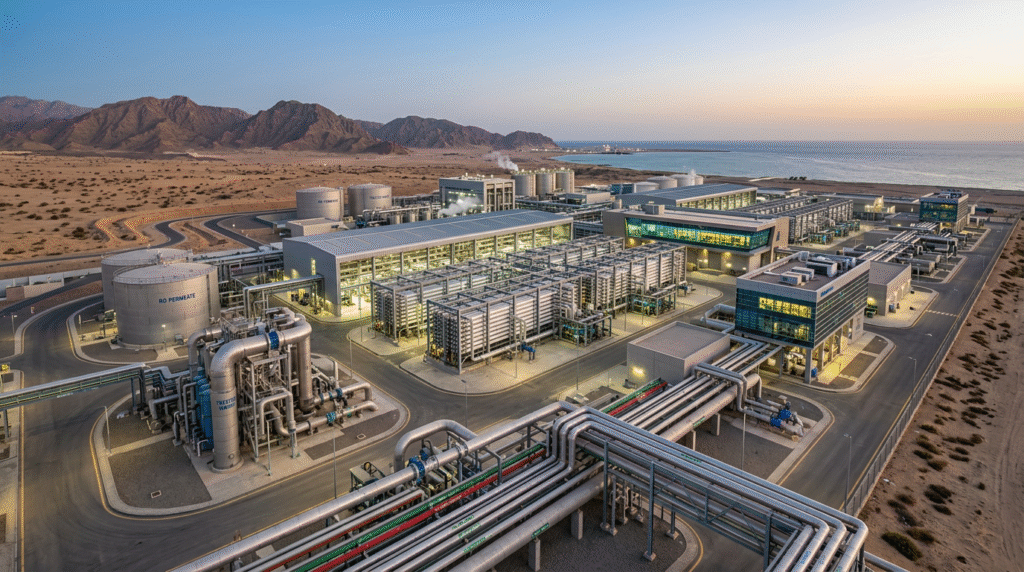
In the Gulf region, water is no longer just a utility, it has become a strategic industrial asset. Rising desalination costs, stricter environmental regulations, and increasing ESG expectations are forcing industries to rethink how water is sourced, treated, reused, and discharged.
Across sectors like manufacturing, energy, chemicals, infrastructure, and processing industries, companies are moving toward smarter and more integrated water-management systems. Instead of relying solely on desalination, modern facilities are combining advanced reverse osmosis (RO), industrial water recycling, wastewater reuse, and Zero Liquid Discharge (ZLD) strategies to improve sustainability while controlling long-term operational costs.
The conversation is no longer only about compliance.
It’s about resilience, efficiency, and building future-ready industrial operations in one of the world’s most water-stressed regions.
Why Water Management Is Different in the Gulf
The Gulf and GCC region face a combination of environmental and industrial challenges rarely seen elsewhere:
- Extremely limited freshwater reserves
- High seawater salinity
- Rapid industrial expansion
- Harsh climate conditions
- Growing environmental scrutiny
- Heavy dependence on desalination infrastructure
In several Gulf countries, over 90% of potable water comes from desalination plants. This makes industrial growth heavily dependent on energy-intensive water-treatment infrastructure.
According to the World Bank’s research on water security in the GCC region, Gulf nations are increasingly investing in long-term water resilience and infrastructure modernization to address rising demand and climate pressures.
This creates a unique challenge for industries.
On one side, desalination enables large-scale industrial growth in arid environments.
On the other, increasing energy costs, brine-discharge concerns, and sustainability regulations are making traditional water-management models less viable over time.
Desalination Remains Essential, But It’s No Longer Enough
Desalination has been the backbone of Gulf development for decades. Modern RO-based desalination plants now supply massive volumes of freshwater to cities, industrial clusters, and infrastructure projects across the region.
These systems have enabled economic growth in environments where freshwater availability is naturally limited.
However, desalination alone cannot solve the region’s long-term water challenges.
The major concerns include:
- High energy consumption
- Rising operational costs
- Marine impact from concentrated brine discharge
- Increasing carbon-reduction pressure
- Dependency on centralized infrastructure
For industrial facilities, every cubic meter of desalinated water carries a significant operational cost. Without efficient reuse systems, this can directly impact profitability and long-term sustainability goals.
According to insights from Global Water Intelligence, industries across the Middle East are increasingly shifting toward integrated water-management systems that combine desalination with reuse and recycling technologies.
Industrial Water Recycling Is Becoming a Core Strategy
Industrial water recycling is rapidly moving from a “sustainability initiative” to a core operational requirement across the Gulf.
Facilities that once treated wastewater only to meet discharge standards are now engineering systems to recover and reuse treated water internally.
Instead of discharging valuable treated streams, industries are redirecting them toward:
- Cooling towers
- Utility systems
- Process makeup water
- Cleaning operations
- Secondary industrial applications
This shift delivers multiple operational benefits simultaneously.
Benefits of Industrial Water Recycling
- Reduces dependence on expensive desalinated water
- Lowers freshwater intake requirements
- Decreases wastewater discharge volumes
- Helps facilities meet stricter environmental regulations
- Reduces overall operational and chemical costs
Industry reports on water reuse in arid regions suggest that integrated recycling systems can reduce freshwater demand by 30–40% in certain industrial environments without compromising operational reliability.
Advanced reuse technologies highlighted by Veolia Water Technologies demonstrate how closed-loop industrial systems are becoming increasingly important in high-salinity and water-stressed regions.
The Growing Role of Advanced RO Systems
Reverse Osmosis (RO) technology continues to play a central role in Gulf-region water infrastructure.
But operating RO systems in the Gulf is significantly more challenging than in many other parts of the world.
High salinity, elevated Total Dissolved Solids (TDS), scaling salts, suspended particles, and harsh temperatures place enormous stress on treatment systems and membranes.
This makes system design extremely important.
Effective Gulf-ready RO systems typically include:
- Advanced pretreatment systems
- Multi-media filtration
- Chemical softening
- Antiscalant dosing
- High-recovery membrane configurations
- Real-time monitoring and automation
Modern industrial RO systems are increasingly being designed for flexibility and scalability.
This is particularly important in expanding industrial zones and economic corridors where future capacity requirements may change rapidly.
Why ZLD and Brine Minimization Are Gaining Attention
As environmental regulations become stricter across the GCC, industries are facing growing pressure to minimize liquid discharge and reduce environmental impact.
This is driving increased interest in:
- Zero Liquid Discharge (ZLD) systems
- Brine concentration technologies
- High-recovery RO systems
- Evaporation and crystallization solutions
ZLD systems help facilities recover usable water while minimizing wastewater discharge.
Although these systems require higher upfront investment, they are becoming increasingly attractive for industries operating in environmentally sensitive or regulation-heavy sectors.
In high-salinity industrial environments, brine management is now becoming just as important as freshwater production itself.
Breaking the Traditional Water-Treatment Model
One of the biggest shifts happening across Gulf industries is the move away from siloed water infrastructure.
Traditionally, desalination, wastewater treatment, and reuse systems were treated as separate operations.
Today, leading facilities are integrating them into a single optimized water-management architecture.
Modern integrated systems are designed to:
- Reserve desalinated water for high-purity applications
- Reuse treated wastewater wherever possible
- Reduce freshwater dependency across the plant
- Optimize water quality continuously
- Improve operational resilience during supply fluctuations
This integrated approach not only improves sustainability metrics but also strengthens long-term operational reliability.
According to SUEZ Water Technologies & Solutions, integrated industrial water-management systems are becoming critical for balancing efficiency, sustainability, and regulatory compliance in rapidly growing industrial regions.
The Future of Industrial Water Management in the Gulf
The Gulf region’s water-management future is shifting from simply producing more water to using water more intelligently.
Desalination will remain essential.
But the next phase of industrial growth will depend on how effectively industries combine:
- Advanced desalination
- Industrial recycling and reuse
- Smart monitoring systems
- High-efficiency RO technologies
- ZLD-ready infrastructure
- Sustainable water optimization strategies
Facilities that invest in flexible and future-ready water-treatment systems today will be better positioned to handle future environmental regulations, operational costs, and sustainability expectations.
Final Thoughts
Water scarcity is one of the defining industrial challenges of the Gulf region, but it is also driving innovation.
Industries are no longer viewing water treatment as a standalone utility function. Instead, it is becoming a strategic component of operational efficiency, sustainability, and long-term resilience.
By combining desalination, advanced RO systems, industrial recycling, and reuse strategies into a unified approach, Gulf-region industries can reduce costs, improve compliance, and build more sustainable operations for the future.
In an increasingly water-constrained world, smarter water management is no longer optional.
It’s a competitive advantage.
Whether it’s desalination, reuse, or industrial recycling, Gulf-region facilities increasingly require water-treatment solutions tailored to their specific operating conditions.