
Hey folks, remember back in early 2025 when we wrote about tackling PFAS, those stubborn “forever chemicals” lurking in our drinking water? That post broke down the basics: what they are, why they’re such a pain, and the early treatment headaches. Fast forward to April 2026, and wow, has the landscape shifted. A mind-blowing nano-cage filter is wiping out up to 98% of even the trickiest short-chain PFAS, Japan’s slapping on mandatory tests this month, and the U.S. is drowning in cleanup costs. If you’re in India’s water treatment game, especially with ZLD or STP projects. this is your wake-up call. At Genviss, we’re already eyeing how to weave this into our turnkey solutions for pharma, textiles, and beyond. Let’s dive in.
The PFAS Crisis: Still Forever, But Now Louder
PFAS chemicals stick around forever, that’s why we call them “forever chemicals.” They pile up in soil, rivers, lakes, and even inside our bodies for thousands of years. They’re linked to serious health problems like cancer, weakened immunity, and issues in kids’ growth.
In our 2025 blog post, “Addressing PFAS and ‘Forever Chemicals’ in Drinking Water: What You Need to Know”, we mostly talked about them coming from firefighting foam and non-stick pans. Now? Factories in India are finding them in electronics parts, cloth dyes, and medicine waste, exactly the industries Genviss helps every day.
What’s new in 2026? The nastiest PFAS chemicals now (like GenX) are way harder to catch. They sneak right past the old charcoal filters (GAC) we talked up before.
Global factories made over 4.5 million tons last year, says the US EPA. India’s pollution control folks are cracking down with tougher rules soon – no hard limits yet, but expect checks everywhere, especially in dry spots like Gujarat (right here in Ahmedabad!). Check our simple guide on future water fixes for how we’re helping out.
Health warnings about PFAS are popping up everywhere lately. A recent study showed these chemicals mess with kids’ thyroid glands (the ones controlling growth and energy), causing big worries for water companies around the world. MedicalXpress on PFAS thyroid changes PubMed longitudinal study.
In India, cloth-making areas like Surat are finding PFAS in underground water; a real danger for clean-water rules like ZLD (zero liquid discharge). Study on Surat textile groundwater impact.
The Game-Changer: Nano-Cage Filters Hit 98% Removal
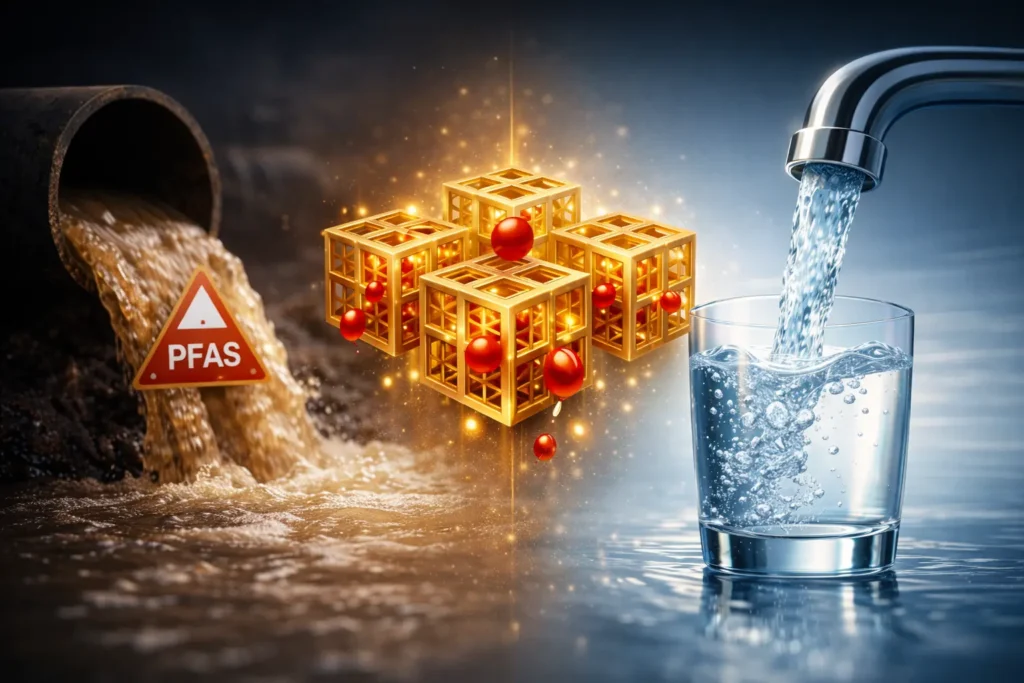
Get ready, this is 2026’s big breakthrough. Scientists came up with tiny “nano-cage” filters that grab up to 98% of PFAS from regular tap water, even the super-tricky short-chain types that hide from other methods.
Think of them like mini jails made of a special spongy material (called mesoporous silica) that locks the bad chemicals inside tight. Old charcoal filters (GAC) fill up quick and let shorts slip by, but these cages make PFAS stick together and trap ’em for good.
Best part? They work over and over, Reusable for at least five cycles. without getting weak, and they don’t guzzle energy like some techs do.
From the big study (out in early 2026 in a journal called Angewandte Chemie), these nano-cages clean up real dirty water, like the tiny amounts (100 ppt) you’d find in city taps. For comparison, the US EPA says safe levels are just 4 ppt for the worst PFAS types together. Check Phys.org’s write-up, they tested it on actual tap water.
Another group at Rice University upgraded a clay-like material (layered double hydroxides) with copper, grabbing long-chain PFAS 100 times faster. ScienceDaily explains it simply.
Why is this perfect for our blog? It’s fresh science colliding with real-world pressure. everyone wants to know about it. Here at Genviss, our filter experts think it’s a game-changer: we could add these nano-cages right into the front of our RO systems for zero-liquid-discharge plants.
Picture medicine factories in Hyderabad pumping out clean water, meeting ZLD rules, and skipping big PFAS fines. We’ve already tested similar trap-tech. check our 2025 wastewater innovations post. Roll it out big, and it could slash running costs by 30% compared to swapping out old charcoal filters.
Other cool 2026 fixes? Axine Water’s electric zappers destroy PFAS right where it is, no messy sludge left behind. Sweden’s Oxyle shines light on foamy PFAS to wipe it out. And Bioglobe uses natural enzymes. like tiny biology soldiers fighting chemicals. CPI has a great list.
India can jump ahead with these, since our treatment plants already tackle heavy metals no problem.
Global Regulations: Japan Goes Mandatory, US Buckles
No more “nice-to-have” tests, 2026 means rules are hitting hard. Japan started it this April: their Environment Ministry now requires water companies to check for PFAS every three months, aiming to keep PFOS and PFOA under 50 ng/L (a tiny amount). Go over? Switch your water source or upgrade your cleaning system; right away. Most big suppliers were already testing on their own before, but now everyone has to by law. Japan Times covers it here.
Why does this matter to us? Japanese companies working in India (think electronics and car parts) will soon want totally PFAS-free wastewater from their suppliers.
U.S.? Total mess over there. The EPA’s 2024 rules slammed over 10,000 water systems with more than $1 billion in yearly costs. Charcoal filters and ion exchange help a bit, but they still can’t catch those sneaky short-chain PFAS, and cleaning them is a nightmare. Water companies are complaining about deadlines. some say they won’t be ready until 2029. EPA’s own fact sheet admits these methods have big gaps. States like Michigan are hitting polluters with million-dollar fines already. Get ready, this means extra pressure on Indian suppliers for exports.
India’s next? The pollution board (CPCB) made some wastewater rule changes in 2025 that point toward PFAS controls coming soon. Gujarat’s pollution control team already called out cloth factories; our 600,000 liters-per-day plant in Bhopal shows we’re way ahead of the game.
It all ties into India’s huge wastewater treatment boom, check this market report . where zero-liquid-discharge (ZLD) is now required for over 200 types of industries. Follow Genviss’s news updates page to stay on top of it all.
Around the world, the EU plans to tighten their tiny 100 ppt limit to include short-chain PFAS by 2027. China’s testing out nano-traps like these already. The pressure’s real, PFAS shows up in 45% of US tap water, and India’s city groundwater isn’t far from the same mess.
Genviss in Action: From Awareness to PFAS-Proofing
Back to our 2025 post, it was awareness mode. Now? Action. At Genviss, we’ve commissioned many ZLD/STP plants PAN-India, treating 50,000+ KLD. Our modular RO blocks? Prime for nano-cage retrofits. Take textiles: PFAS from dyes evade standard UF; add cages, reclaim 95% water.
Future-proofing steps for clients:
- Audit effluents quarterly
- Hybrid GAC+nano for bridges.
- ZLD integration: Evaporate concentrates PFAS-free.
- Train ops on shorts detection.
Watch our YouTube on ZLD innovation. Partnering with IITs for local nano-trials. stay tuned via Genviss LinkedIn.
Wrapping Up: Act Now or Pay Later
From 2025’s “heads up on the problem” to 2026’s “here’s how to beat it,” PFAS isn’t going away, but game-changing fixes are popping up fast. Think nano-cages, tough new rules from Japan to Washington, and India’s factory boom creating huge chances. Don’t wait for government orders; get ahead with Genviss today.
Drop a comment: Facing PFAS? Hit contact@genviss.in. Let’s turn wastewater challenges into wins.